
Understanding Chronic Lateness and ADHD Through Personal and Developmental Perspectives
The complex relationship between chronic lateness and attention deficit disorder, viewing these challenges through the lens of brain development and emotional maturity. Also a distorted perception of time often originates from environmental stress and early childhood experiences rather than being a simple character flaw. Let's dive in.
Anonymous
2/15/20262 min read
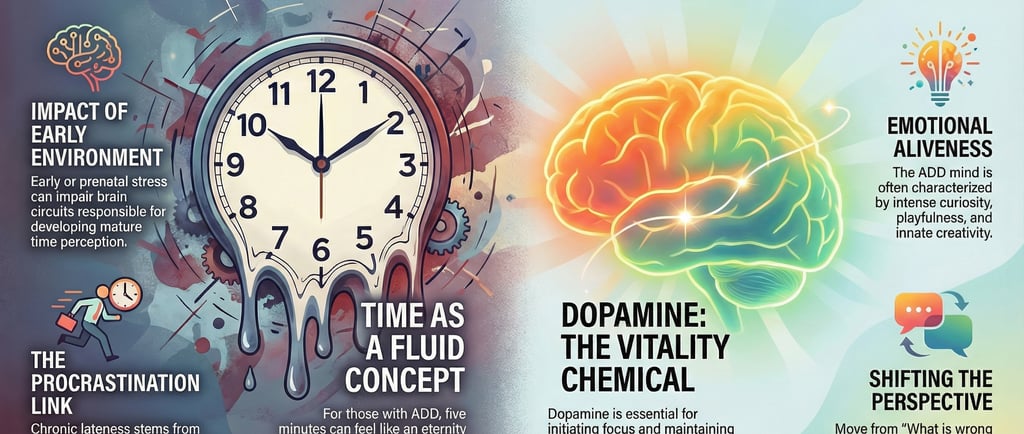
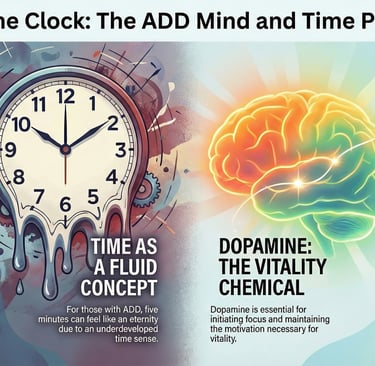
Have you ever found yourself racing against the clock, heart pounding, only to arrive ten minutes late—again? For many, chronic lateness is seen as a character flaw or a sign of disrespect. However, according to the sources, chronic lateness is often deeply intertwined with Attention Deficit Disorder (ADD) and the way our brains develop.
If you or someone you love struggles to stay on schedule, it’s time to move past the frustration and look at the science and psychology behind the "time crunch."
It’s Not Laziness; It’s Brain Development
For individuals with ADD, lateness often stems from an underdeveloped "time sense." While most people have a linear perception of time, those with ADD may perceive it differently—for instance, feeling that "five minutes until eight" is an eternity.
This isn't a choice; it's a reflection of uneven brain maturation. In many adults with ADD, certain aspects of their personality may be highly advanced, while their sense of time and emotional regulation remains underdeveloped. Research suggests that these brain circuits can be impaired by environmental stress experienced as early as infancy or even prenatally. Highly sensitive infants are particularly vulnerable to parental stress, which can trigger ADD symptoms as a survival response rather than a purely genetic trait.
The Dopamine Connection
Why can some people with ADD be perfectly on time for a high-stakes meeting but late for coffee with a friend? The answer lies in dopamine.
Dopamine is the brain chemical responsible for motivation, curiosity, and the ability to initiate tasks. When someone is highly motivated, they can often override their typical time-blindness. However, without that surge of interest or urgency, the brain struggles to "kick-start" the necessary focus, leading to procrastination and the inevitable last-minute rush.
From "What's Wrong?" to "What Happened?"
Society often greets lateness with condemnation, leading to a cycle of self-judgment and self-hate. The sources suggest a more empathetic approach: shifting the question from "What is wrong with you?" to "What happened to you?"
When we view chronic lateness as a coping mechanism shaped by early life experiences rather than a character flaw, we open the door to real change. Interestingly, the same "emotional aliveness" and curiosity that lead to ADD struggles are also the hallmarks of creativity and playfulness. Many successful creative professionals and comedians share these exact traits.
Balancing Understanding and Responsibility
Understanding that your lateness may be rooted in developmental stress or brain physiology is not an "escape hatch" from accountability. Instead, it is a tool for self-awareness and agency.
• Curiosity over Condemnation: Instead of beating yourself up, practice curiosity about why you are struggling to start a task.
• Healing through Awareness: Recognizing how past traumas or stressful environments shaped your behavior allows you to prevent those influences from imposing on your current relationships.
• Adaptability: Growth involves learning to adjust your behavior to your environment without losing your essential kindness or personality.
The Bottom Line: Chronic lateness is a complex intersection of biology and biography. By replacing blame with understanding, individuals can begin to manage their time more effectively while maintaining their "emotional aliveness" and creative spark.
Sources:
Dr. Gabor Mate: Attention Deficit Disorder: https://www.youtube.com/watch?v=cW3Md09-jfc
Google NotebookLM: https://notebooklm.google/
If it is too much to read, here is an explainer video created by NotebookLM

Get in touch
We really appreciate your comments or thoughts.
Connect
Share insights and inspire action for change.
Engage
Explore
© 2026. All rights reserved.